
The Rule, and the Exceptions
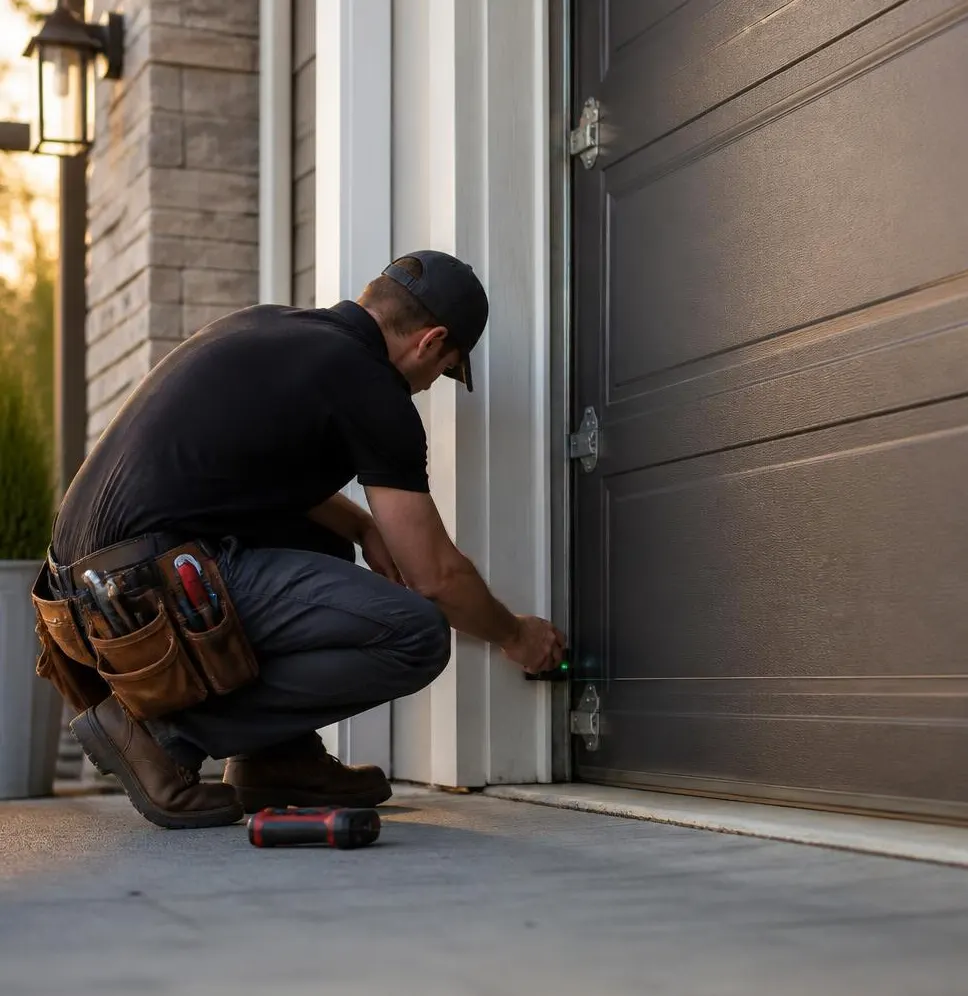
If your garage door reverses before it touches the floor, or won't close at all, assume the photo-eye sensors first. They're the two small boxes mounted a few inches off the ground on either side of the track, and they're responsible for more "mystery" garage door problems than almost any other part. That said, the rule has exceptions: if the door won't close and the opener makes a grinding or straining noise, that's more likely a spring or cable issue. If the door closes fine but then reverses partway up, that's a limit switch or force-setting problem, not the eyes. And if it's genuinely freezing out and the door is sluggish everywhere, cold grease and a tight track can mimic a sensor fault. Rule out an actual obstruction first, then check the sensors before anything else.
What the Photo Eyes Actually Do
The two sensors send an invisible infrared beam across the bottom of the doorway. As long as that beam is unbroken, the opener is allowed to close the door. Break the beam — with a bike, a box, a kid, a dog, a bumper — and the opener either refuses to close or reverses immediately if it's already moving down. This is a federally mandated safety feature on every residential opener made since the mid-1990s, and it exists because garage doors are heavy enough to cause real injury or worse if they close on something living.
What Goes Wrong, and How It Shows Up
- The door won't close at all, and the opener light blinks a set number of times (check your owner's manual for the code).
- The door starts closing, then reverses halfway or near the bottom with no visible obstruction.
- One sensor's LED is dim, flickering, or off instead of steady — that's usually the receiving eye telling you alignment or power is off.
- It works sometimes and not others, often tied to time of day, which usually means direct sunlight is washing out the receiver.
How Bad It Gets
The nuisance version is a door that won't close, which in a Roane County winter means a garage sitting open during an ice storm or a hard freeze — not great for anything stored in there, including vehicles and water lines. The serious version is the opposite problem: sensors that have been disabled or bypassed so the door closes regardless of what's underneath it. That's the scenario the safety feature was built to prevent, and it's not a hypothetical risk for a household with small kids, pets, or anyone who parks right at the sensor line. A door that closes on a bumper can total a taillight; a door that closes on a person or animal is a genuine emergency.
How to Clean and Align Them
- Power down the opener at the wall switch or unplug it before touching anything.
- Wipe both lenses with a soft, dry cloth. In this area, lenses collect fine dust, pollen residue, spiderwebs, and the humidity-driven grime that builds up on anything near an open garage. A smudged lens is the single most common cause of false trips.
- Check for a direct sunbeam hitting the receiving eye in late afternoon or early morning; if so, a small cardboard shade or slight downward tilt usually solves it.
- Look at the brackets. A bump from a bike, a mower, or a car door can knock one eye out of alignment by just enough to break the connection. Both sensors should point at each other and sit at the same height.
- Loosen the mounting screw, nudge gently, and watch the LED on the receiving unit — most units show a steady light when properly aligned and a flicker or no light when they're off.
- Re-power and test by waving something through the beam while the door closes; it should stop or reverse instantly.
If the brackets themselves are bent or the wiring is frayed — which happens more often than people expect in garages that see heavy rain intrusion or pine debris around the door opening — cleaning and aligning won't be enough, and the sensor or bracket needs replacing.
When Not to Bypass Them
Some older opener models technically allow you to hold the wall button to force a close with the sensors disconnected. Don't use this as a workaround for a misaligned sensor. It defeats the one feature standing between a closing door and whatever's in its path, and it's not a fix — it's a liability you're carrying every single day until the real problem is corrected.
When to Call Rockwood Garage Door
If you've cleaned and aligned the eyes and the door still won't cooperate, or the wiring looks damaged, that's when to call. Our Garage Door Opener Repair & Installation service covers sensor replacement, bracket repair, and wiring issues, and our Garage Door Maintenance visits catch this kind of wear before it turns into a door that won't close during an ice storm. We serve Rockwood, Harriman, Kingston, Crossville, Spring City, Midtown, Oliver Springs, and Wartburg, and we show up when we say we will.
If your garage door in Rockwood, TN is reversing, refusing to close, or just acting strange near the floor, give Rockwood Garage Door a call and we'll get it sorted before winter weather makes it worse.