
The One-Sentence Rule
Rule of thumb: commercial and warehouse overhead doors are built to run far more cycles a day under heavier loads, so they use thicker steel, stronger springs and tracks, and different safety systems than a residential garage door. If that settles the argument, great. If not, here's where it gets more complicated than a flat "commercial is just bigger."
Where the Rule Breaks Down
- A detached garage used for a home business — a small workshop, a shop with regular truck deliveries — can see dozens of cycles a day on a door that's still residential-grade, and it will wear out accordingly.
- Some small commercial spaces, like a converted studio or a low-traffic storefront, get by fine with a door closer to residential spec because the door barely moves.
- Size doesn't decide the category by itself. A wide two-car residential door is still built to residential tolerances, not commercial duty cycles, no matter how big it looks.
So the real dividing line isn't square footage. It's how often the door opens and closes, how heavy it is, and what's riding on it not failing mid-cycle.
What Actually Changes Between the Two
Cycle life and springs
Residential torsion springs are typically rated for around 10,000 cycles, which is plenty for a household opening the door a few times a day for years. Commercial and warehouse doors use oil-tempered springs rated for 25,000 to 50,000+ cycles, because a loading dock door might open and close that many times in a single year, not a decade.
Track and hardware
Commercial doors run on heavier-gauge steel tracks with ball-bearing rollers instead of the lighter nylon rollers common on residential doors. The horizontal struts reinforcing the panels are heavier too, which matters for wind load on a larger opening and for doors that take more daily abuse from forklifts, pallets, and delivery traffic brushing past.
Operators
A residential opener is a consumer-grade chain or belt drive built for maybe five or six cycles a day. Commercial operators are usually jackshaft or trolley units rated for continuous duty, paired with separate photo-eye and safety-edge sensors required for doors that see constant foot and vehicle traffic nearby.
Panel material and insulation
Warehouse doors are often insulated steel sandwich panels designed to hold a temperature inside a large open space — useful here given how hot and humid summers get and how damp garages stay from spring rain. Residential doors are usually a single layer of insulated steel or aluminum, adequate for a smaller, tighter space but not built for the same thermal load.
Maintenance: Same Climate, Different Schedule
The weather here doesn't care whether a door is residential or commercial — humidity, pollen, heavy rain, and the occasional ice storm hit both. What changes is how fast wear shows up, because a high-cycle commercial door is doing the job ten times over.
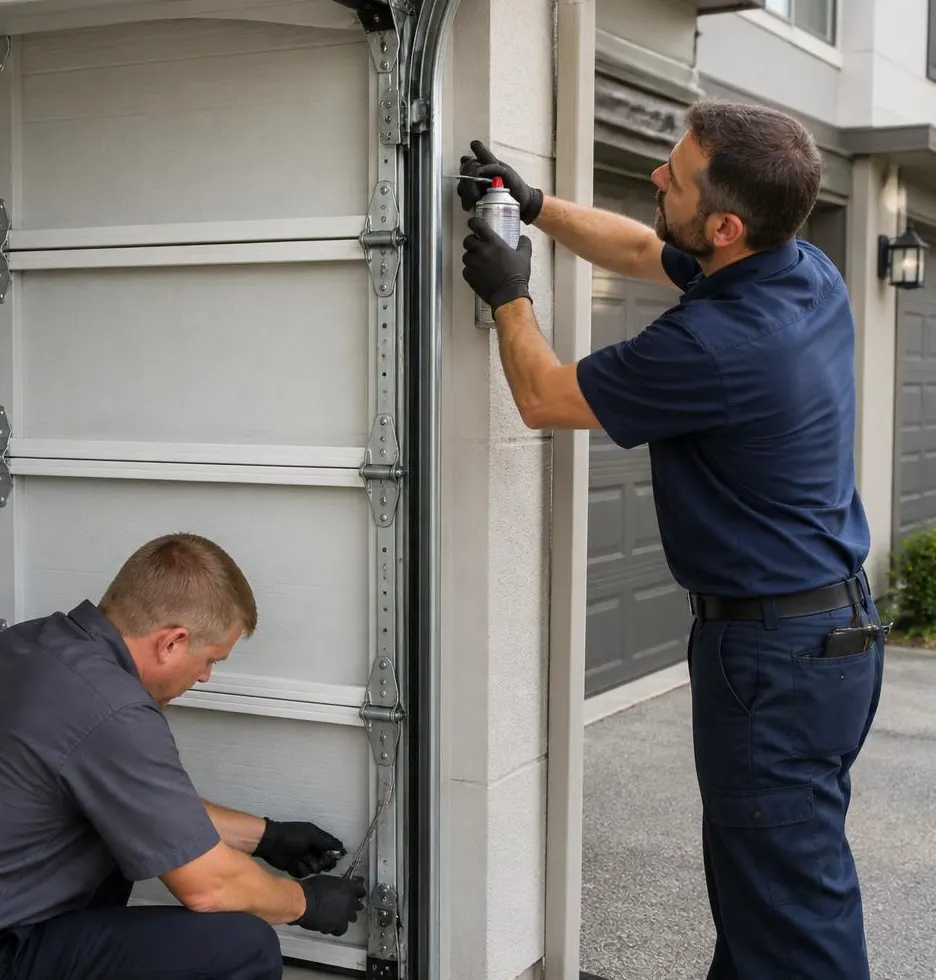
- Lubrication: Residential doors generally need springs, hinges, and rollers lubricated once or twice a season. A commercial door running dozens of cycles a day should get checked monthly, since dried-out hardware fails faster under that kind of use.
- Track and roller buildup: Pine debris and pollen are a given around here, and they pack into track grooves and roller bearings. On a commercial door that's opening constantly, that buildup turns into grinding and misalignment much quicker than on a door that opens twice a day.
- Weatherstripping and bottom seals: Heavy rain runoff and standing moisture around garages and loading areas wear out bottom seals. On warehouse doors protecting inventory or equipment, a cracked seal lets in both water and pests faster than people expect.
- Cable and spring inspection: Higher cycle counts mean cables and springs should be inspected more often, not just when something sounds wrong. Catching a fraying cable before it snaps is a lot cheaper than dealing with a door that's come off track.
- Cold-weather check: Ice storms are occasional but real here. Reinforced commercial doors handle cold better structurally, but seals and lubricant both stiffen in a hard freeze, so a pre-winter check matters for both door types.
When to Call Rockwood Garage Door
If you're running a shop, small business, or warehouse space anywhere from Rockwood out through Harriman, Kingston, or Crossville, and the door is cycling multiple times a day, that's exactly what our Commercial Garage Door Service is built for — checking spring cycle ratings, operator duty cycle, and track wear before they turn into a door that won't open during business hours. For either door type, our Garage Door Maintenance visits catch the lubrication, seal, and alignment issues that pollen, humidity, and ice storms cause before they become a Saturday-morning emergency.
If you're not sure which category your door actually falls into, or it's been doing more cycles than it was built for, give Rockwood Garage Door a call. We serve Rockwood, Harriman, Kingston, Crossville, Spring City, Midtown, Oliver Springs, and Wartburg, and we'll tell you straight what your door needs — no upsell, just the fix that fits.